
Introduction
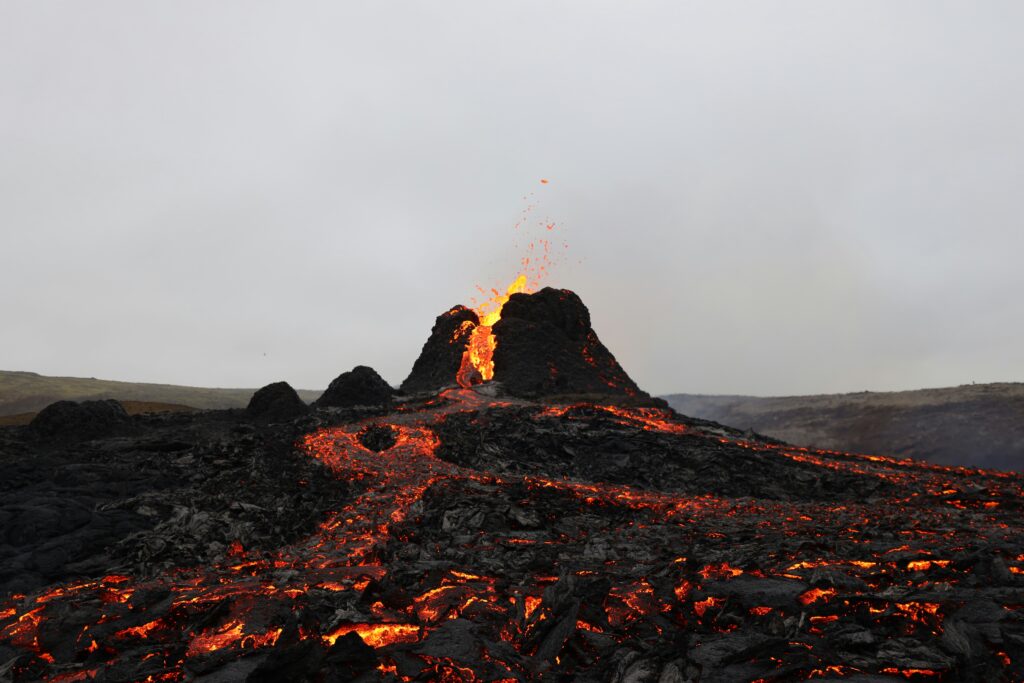
A volcano has an odd relationship with climate change. Like forest fires, volcanoes add to the amount of carbon dioxide in the atmosphere, further exacerbating the issue. With many natural disasters affected by climate change increasing in magnitude and frequency, do volcanoes? Let’s take a look at the literature and see what it says.
Volcanoes and climate
The first article we will look at highlights the impact that volcanoes have on the climate themselves. This is a good starting point, as we have already approached how they impact climate change directly. They also impact the climate in other ways. We will not go into the scientific details surrounding this effect, it involves the deposition of aerosols into the atmosphere from volcanoes etc. to induce an effect on the climate. Cole-Dai J. (2010) highlights that climate models need to improve in their calculations regarding volcanic events. This discrepancy may lead to errors, decreasing the reliability of how the climate will respond in the future. Volcanic eruptions provide a feedback mechanism for climate change, and this effect needs to be taken into consideration. Without these large-scale events being taken into account, we will not be able to accurately describe the shift in climate.
Volcanoes of the past
Volcanoes, having formed large land masses, have been introducing molten rock to the surface of the earth for a long time. With our ability to use proxy data to assess the climate in the past, it makes sense to inspect whether volcanic eruptions have affected the climate in the past. Sadler J.P., Grattan J.P. (1999) reported that volcanic eruptions did not appear to show up on climate data. This is counterintuitive, as we know in todays day and age, that they have an effect. Whether this effect has changed with a change in climate should be looked into. The authors highlight that this does not mean that the volcanic eruptions were not impacting the climate, yet the global average appeared to maintain a steady rate.
Increased frequency?
With most/all other disasters increasing in frequency, it makes sense that volcanoes would as well. Cooper C.L. et al., (2018) report that eruptions are expected to increase in frequency as climate change worsens. The rationale behind this is provided by a model including isostatic rebound. As the glaciers, which were miles thick retracted from the land, that compressive force is also alleviated. This is known as isostatic rebound. Since the ice has been melting in the arctic at an alarming rate, this means that certain areas will see more isostatic rebound. This increases the frequency and potentially the magnitude of volcanoes, as the adjusting land is vulnerable to being in a variable pressure system, leading to the expulsion of the molten rock. The authors highlight that these will impose issues to the local economic and ecological societies as well. This will be for most areas that are surrounded by volcanoes that are subject to this increase in frequency.
Conclusion
Yet again, we are faced with a natural disaster that is increasing in frequency, and potentially magnitude. This corroborates the idea that climate change is something that we must work toward reducing. Human intervention has produced this problem, and it is our responsibility to remove it. Volcanoes are an interesting challenge as they are not affected in a similar way to other disasters we have covered, showing the diverse range of issues that we will face as the climate continues to increase in temperature globally.

References:
1) Cole-Dai J. 2010. Volcanoes and climate. Wiley Interdisciplinary Reviews: Climate Change. 1(6):824–839. doi:https://doi.org/10.1002/wcc.76. https://wires.onlinelibrary.wiley.com/doi/full/10.1002/wcc.76.
2) Sadler JP, Grattan JP. 1999. Volcanoes as agents of past environmental change. Global and Planetary Change. 21(1-3):181–196. doi:https://doi.org/10.1016/s0921-8181(99)00014-4.
3) Cooper CL, Swindles GT, Savov IP, Schmidt A, Bacon KL. 2018. Evaluating the relationship between climate change and volcanism. Earth-Science Reviews. 177:238–247. doi:https://doi.org/10.1016/j.earscirev.2017.11.009. https://www.sciencedirect.com/science/article/pii/S0012825217301629.